Weigh Your Bias

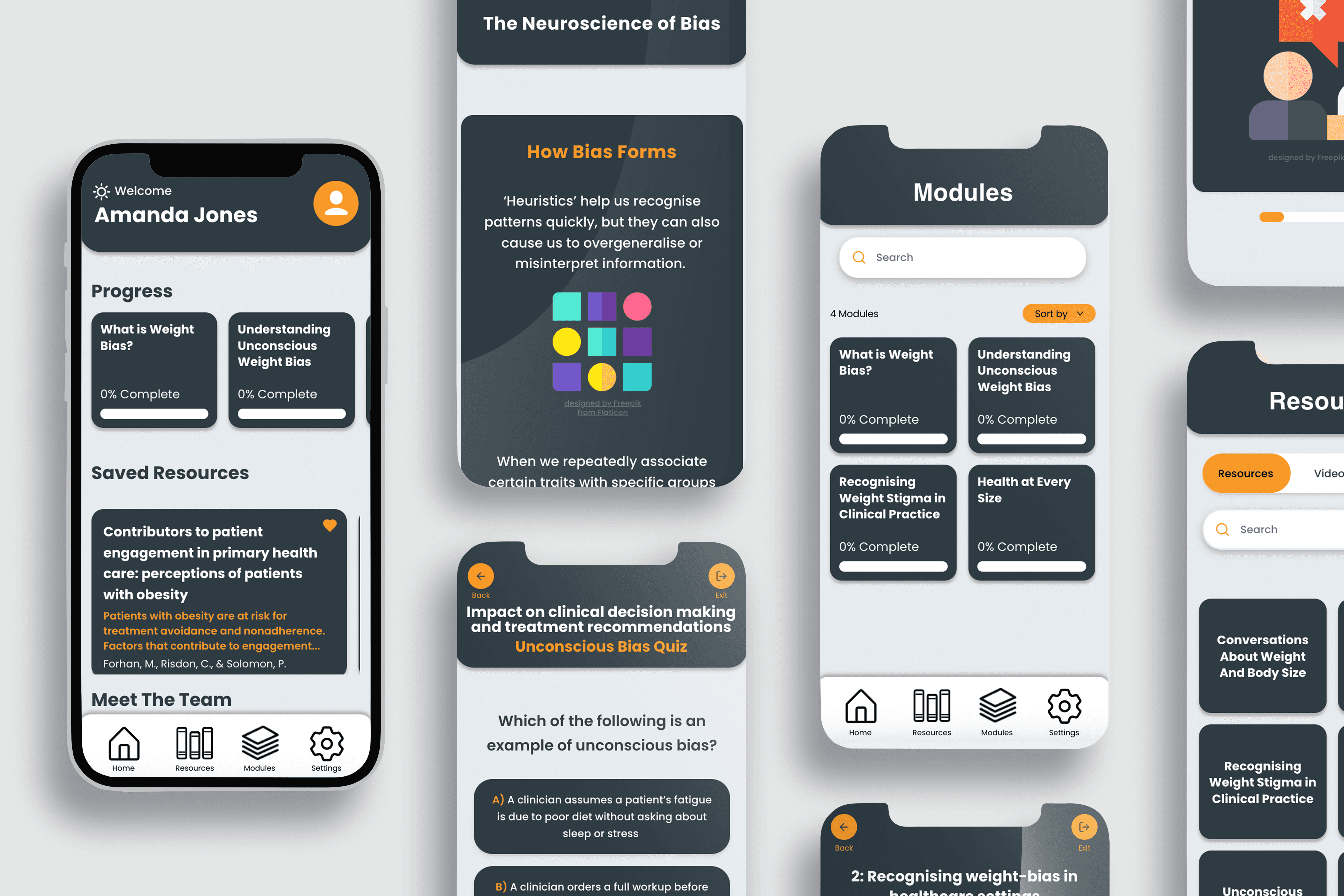
This project addresses weight bias in healthcare, not just in how professionals are trained, but in how clinical spaces and equipment are designed for one body size by default. The outcome was a web application targeting both practitioner attitudes and the physical environment of care.


What started as a third-year UX assignment earned its way out of the classroom. During the final presentation at Te Herenga Waka — Victoria University of Wellington, the concept drew interest from healthcare professionals in the audience, one of whom brought it to Essential Helpcare, a company specialising in equipment and support for bariatric care.


This project addresses weight bias in healthcare, not just in how professionals are trained, but in how clinical spaces and equipment are designed for one body size by default. The outcome was a web application targeting both practitioner attitudes and the physical environment of care.


What started as a third-year UX assignment earned its way out of the classroom. During the final presentation at Te Herenga Waka — Victoria University of Wellington, the concept drew interest from healthcare professionals in the audience, one of whom brought it to Essential Helpcare, a company specialising in equipment and support for bariatric care.


Within the team, I conducted UX research during the university phase and later contributed to UX/UI design and development, coding the web application in TypeScript during the funded phase.

From there, the project received funding and moved into testing with healthcare professionals in Australia. Development is currently paused while further funding is secured to expand the platform with additional modules.
Project type

Project type

Mobile App

Mobile App

Client

Client

Essential Helpcare

Essential Helpcare

Year

Year

2025

2025

Essential Helpcare

Client

Within the team, I conducted UX research during the university phase and later contributed to UX/UI design and development, coding the web application in TypeScript during the funded phase.

Within the team, I conducted UX research during the university phase and later contributed to UX/UI design and development, coding the web application in TypeScript during the funded phase.

Weigh Your Bias

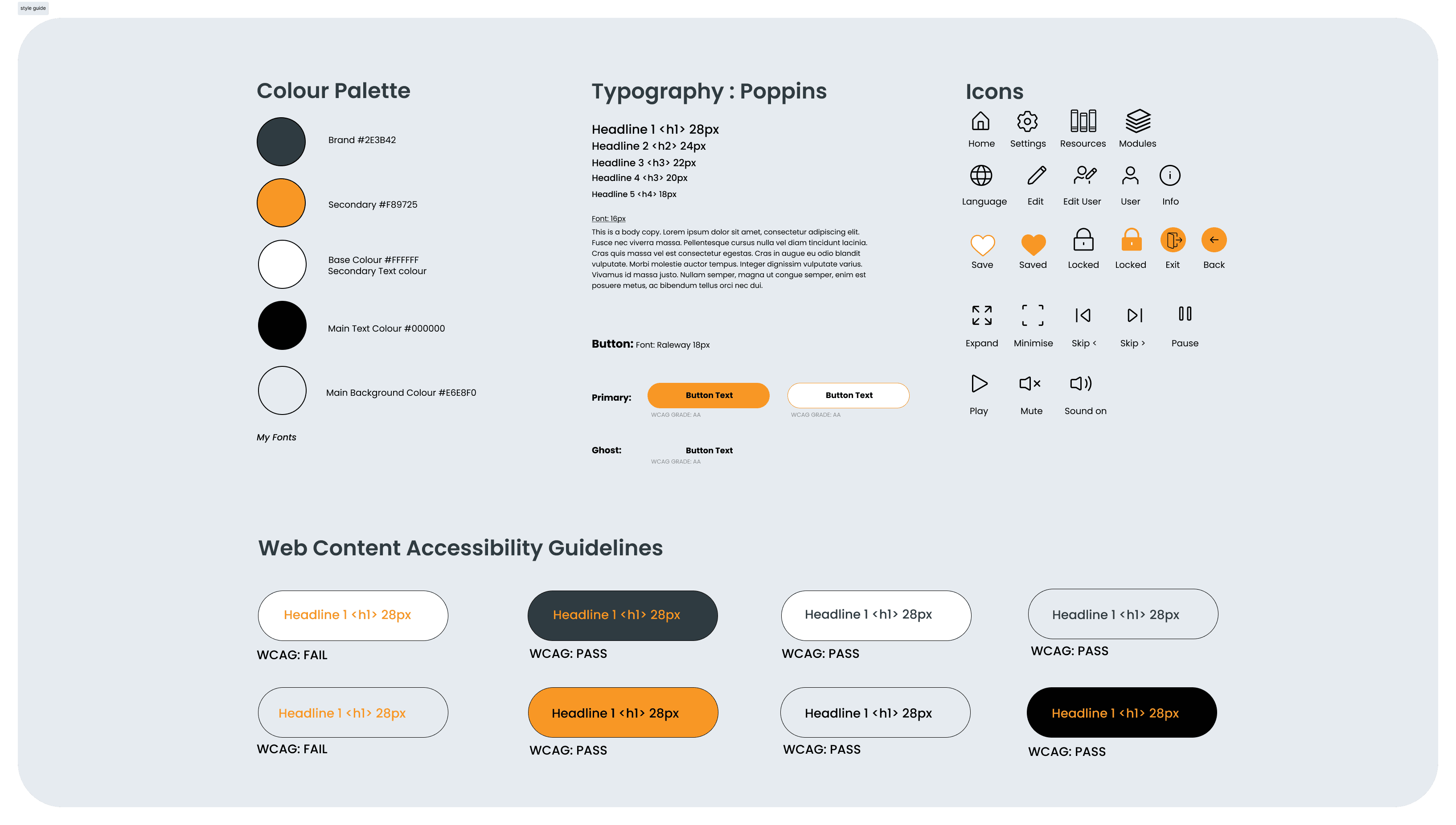
The visual identity draws from Essential Helpcare's existing colour palette, situating the platform within their broader suite of resources. The palette pairs a deep blue with a bold orange accent against a light neutral background, tones that feel professional and clear without being clinical or cold. The contrast between the two works functionally as well as aesthetically, with the orange carrying interactive elements and calls to action while the navy anchors the brand. All colour combinations were tested against WCAG accessibility standards to ensure the platform remained inclusive, particularly important for a product addressing equity in healthcare.


The measure of the project wasn't the design itself but where it went. Receiving funding from Essential Helpcare and moving into testing with healthcare professionals in Australia meant the work had to hold up beyond the classroom, against real practitioners, in a real organisational context.


The hardest design problem wasn't technical. Designing for bias means the content itself can replicate the problem it's trying to solve. The wrong language, the wrong framing, the wrong visual choices can reinforce stigma while claiming to address it. Every decision required that kind of double-checking, which changed how I think about what responsible design actually demands.

Early feedback from healthcare professionals in Australia pointed to something the design had aimed for but couldn't guarantee,  that scenario-based learning was prompting genuine reflection rather than just correct answers. That distinction matters. The goal was never to tell practitioners what to think, but to create the conditions where they might think differently.
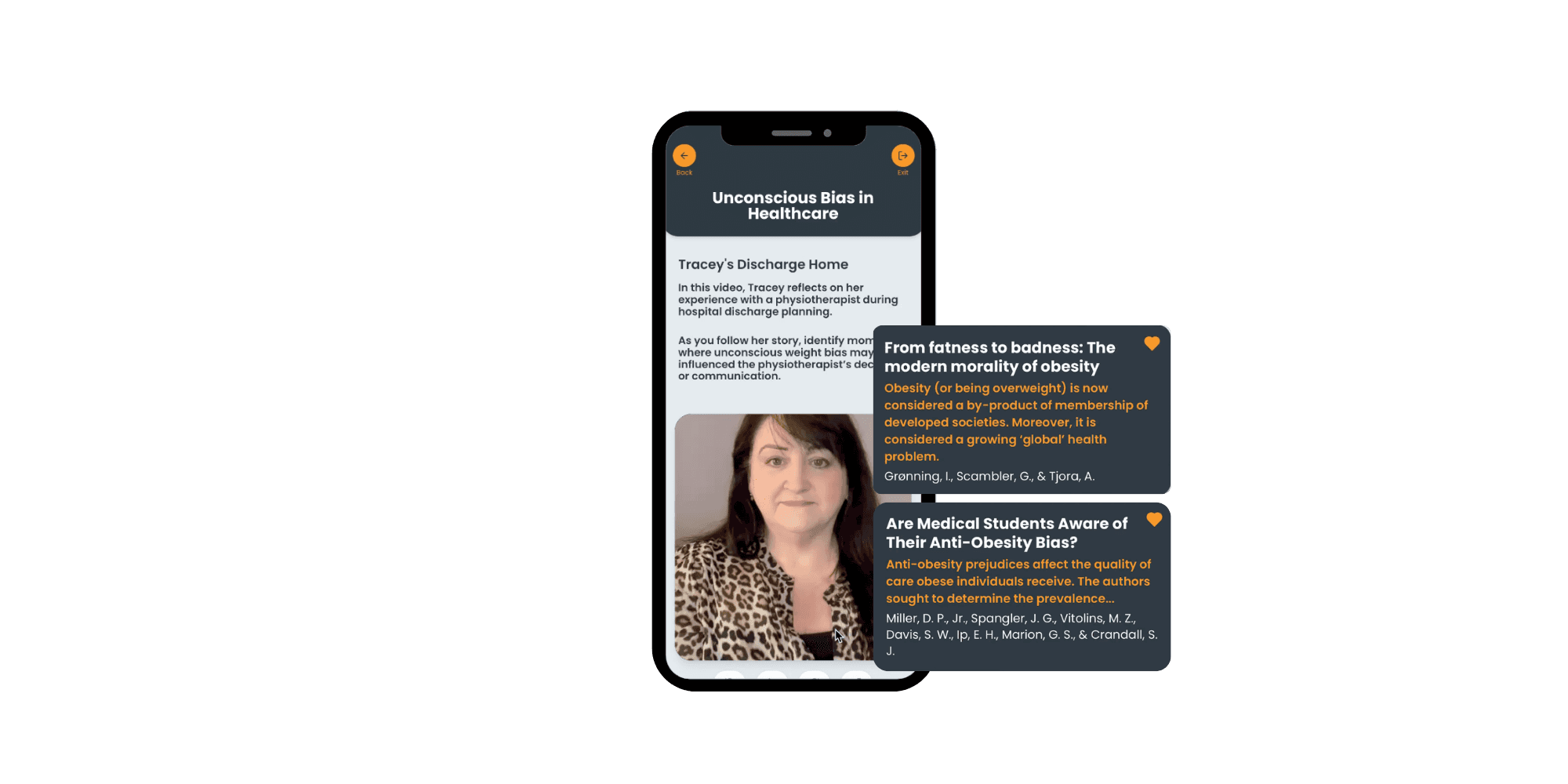
Scenarios train recognition, but they can't fully convey what it feels like to be on the receiving end of bias. The readings and video content fill that gap — grounding the learning in lived experience rather than clinical abstraction. Hearing directly from patients shifts the exercise from intellectual to empathetic, which is where behavioural change actually starts.
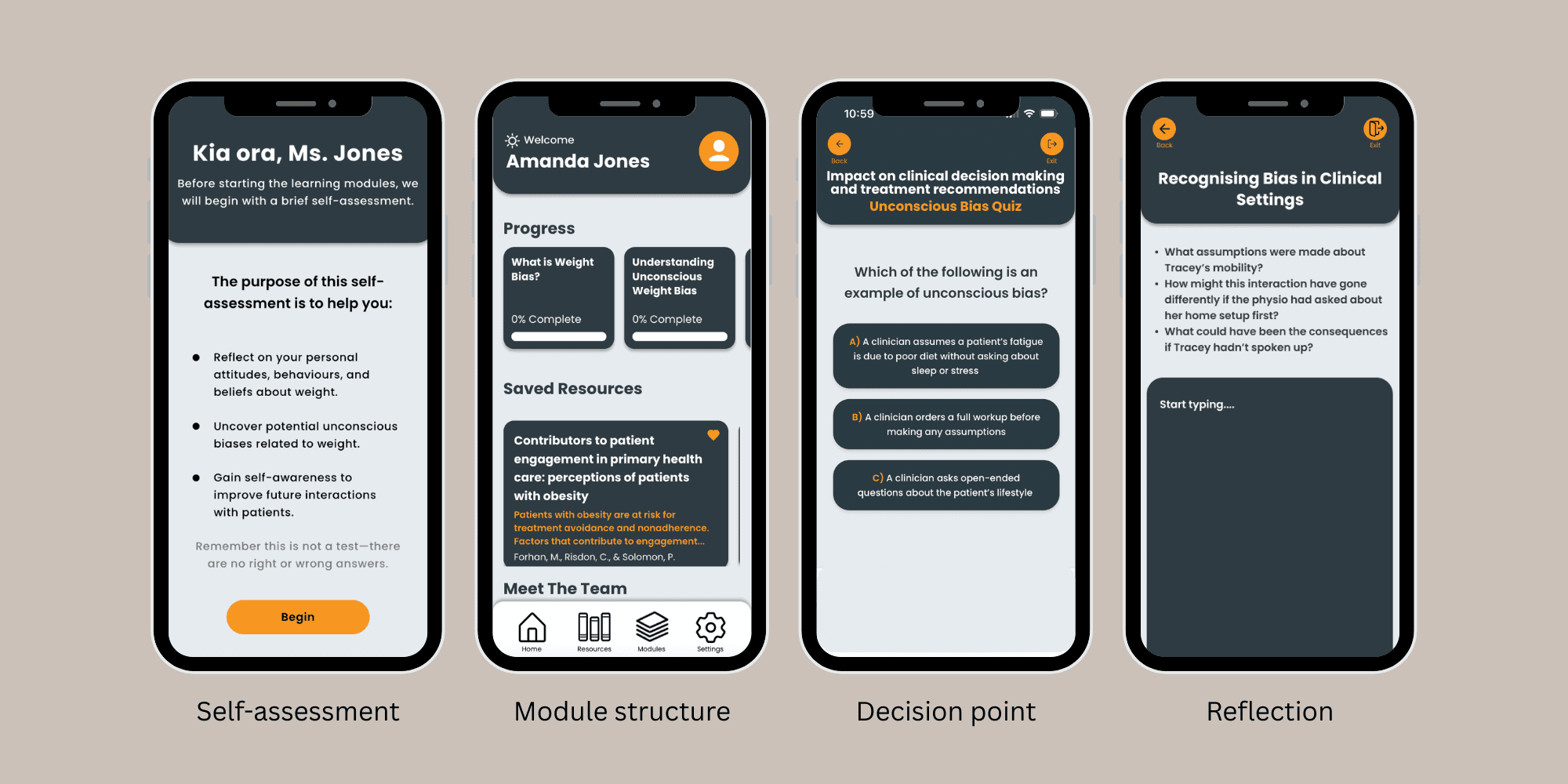
The platform is organised into modules, each targeting a different dimension of weight bias, from clinical communication to the physical environment of care. Within each module, scenario-based interactions move practitioners through moments of decision and reflection rather than passive content consumption.
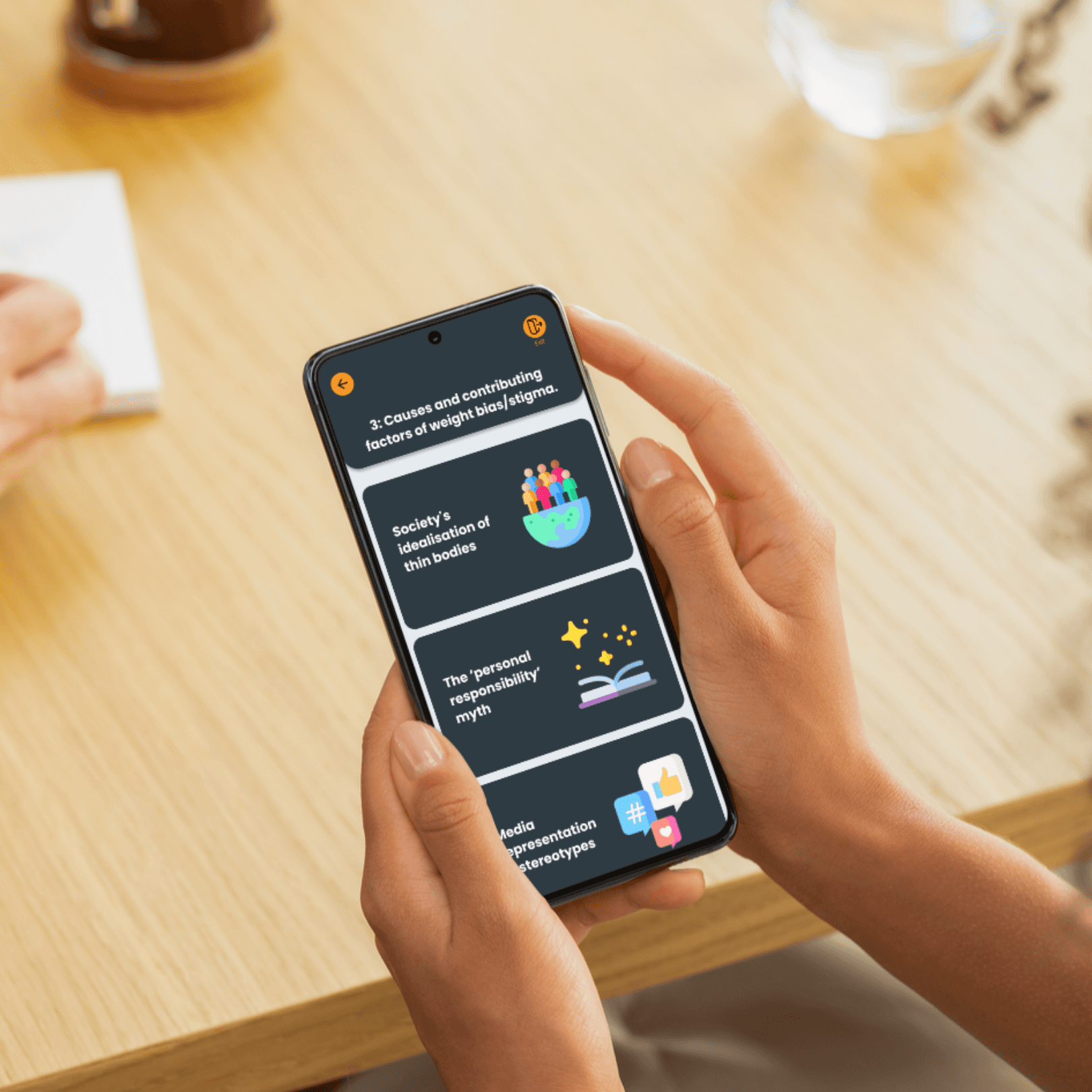
The design went through several iterations, with the most significant refinements around how feedback was delivered, early versions were too directive, which risked triggering defensiveness rather than reflection. The final approach holds back judgment and leads with questions instead

The design went through several iterations, with the most significant refinements around how feedback was delivered, early versions were too directive, which risked triggering defensiveness rather than reflection. The final approach holds back judgment and leads with questions instead

The design went through several iterations, with the most significant refinements around how feedback was delivered, early versions were too directive, which risked triggering defensiveness rather than reflection. The final approach holds back judgment and leads with questions instead

By revisiting familiar interactions in a controlled environment, practitioners are encouraged to consider how communication, assumptions, and decision-making can shape patient experiences and outcomes.

Traditional training tells professionals what bias is. The scenario-based learning module puts them inside a clinical situation where they have to make decisions, and then asks them to consider how bias may have shaped those decisions. The difference is the difference between knowing something and recognising it in yourself.

By revisiting familiar interactions in a controlled environment, practitioners are encouraged to examine how communication, assumptions, and decision-making shape patient experiences, not in the abstract, but in situations that mirror their actual practice.

Feedback is framed to support reflection rather than correction. The goal isn't to identify wrong answers but to surface the reasoning behind decisions, making bias visible in a way that defensive responses are less likely to shut down.

By revisiting familiar interactions in a controlled environment, practitioners are encouraged to examine how communication, assumptions, and decision-making shape patient experiences, not in the abstract, but in situations that mirror their actual practice.

Traditional training tells professionals what bias is.

The scenario-based learning module puts them inside a clinical situation where they have to make decisions, and then asks them to consider how bias may have shaped those decisions. The difference is the difference between knowing something and recognising it in yourself.

Feedback is framed to support reflection rather than correction. The goal isn't to identify wrong answers but to surface the reasoning behind decisions, making bias visible in a way that defensive responses are less likely to shut down.

The project began as a topic given to us to explore through interaction design, and weight bias in healthcare was one I hadn't encountered before. That unfamiliarity became a starting point. The more I researched, the more I found a system where prejudice was embedded in routine practice, often unacknowledged by the professionals perpetuating it. That gap between how healthcare professionals perceive their own practice and how patients experience it became the central problem the design needed to address.

Weight bias in healthcare isn't just an attitude problem, it shapes the care patients receive. In Aotearoa New Zealand, where obesity is a significant health challenge, many patients encounter judgment and generic advice instead of personalised support. The bias is systemic, and it often goes unexamined precisely because it's embedded in routine practice.


Weigh Your Bias is an educational web app designed to change that, helping healthcare professionals recognise and address their own biases through empathy-building and reflective practice.

Weight Bias in Clinical Interactions

Weight Bias in Clinical Interactions

The consequences don't stay in the clinic, they compound.

The consequences don't stay in the clinic, they compound.

User research surfaced a consistent pattern: patients felt judged before they were heard. Many reported poor communication from providers, distress around the visibility of their condition, and a growing reluctance to seek care at all. Negative healthcare experiences weren't isolated — they compounded, making routine interactions outside of healthcare harder too.

Secondary research and literature review grounded the content in something real. Weight bias in healthcare is well documented academically, and drawing on existing research meant the scenarios reflected patterns that practitioners actually encounter rather than hypothetical situations. From there, the design was tested early and often.

The research process started with the people most affected. Personas and journey mapping weren't just structural tools — they surfaced the emotional weight of healthcare interactions for patients experiencing weight bias, which shaped how the scenarios were written and what moments of decision-making were worth focusing on.

Low-fidelity wireframes let ideas be challenged before they were built, and usability testing continued through later iterations, with the most significant feedback coming around how feedback itself was delivered. Heuristic evaluation kept the experience honest: clear hierarchy, consistent interaction patterns, and a structure that never made the user work harder than the content required.

Patients feel judged or dismissed

Patients feel judged or dismissed

Breakdown of trust and communication

Breakdown of trust and communication

Avoidance of care and delayed treatment

Avoidance of care and delayed treatment

Worsening health outcomes

Worsening health outcomes

Reinforcement of weight bias in healthcare

Reinforcement of weight bias in healthcare

“The way I get treated in any healthcare facility… I’m judged on my appearance.”


- Tracey Carr, Patient’s Perspective: Plus-Size Patient Experience in Healthcare

Low-fidelity wireframes let ideas be challenged before they were built, and usability testing continued through later iterations, with the most significant feedback coming around how feedback itself was delivered. Heuristic evaluation kept the experience honest: clear hierarchy, consistent interaction patterns, and a structure that never made the user work harder than the content required.

Secondary research and literature review grounded the content in something real. Weight bias in healthcare is well documented academically, and drawing on existing research meant the scenarios reflected patterns that practitioners actually encounter rather than hypothetical situations. From there, the design was tested early and often.

Weight bias in healthcare isn't just an attitude problem, it shapes the care patients receive. In Aotearoa New Zealand, where obesity is a significant health challenge, many patients encounter judgment and generic advice instead of personalised support. The bias is systemic, and it often goes unexamined precisely because it's embedded in routine practice.


Weigh Your Bias is an educational web app designed to change that, helping healthcare professionals recognise and address their own biases through empathy-building and reflective practice.

The project began as a topic given to us to explore through interaction design, and weight bias in healthcare was one I hadn't encountered before. That unfamiliarity became a starting point. The more I researched, the more I found a system where prejudice was embedded in routine practice, often unacknowledged by the professionals perpetuating it. That gap between how healthcare professionals perceive their own practice and how patients experience it became the central problem the design needed to address.

User research surfaced a consistent pattern: patients felt judged before they were heard. Many reported poor communication from providers, distress around the visibility of their condition, and a growing reluctance to seek care at all. Negative healthcare experiences weren't isolated — they compounded, making routine interactions outside of healthcare harder too.

“The way I get treated in any healthcare facility… I’m judged on my appearance.”


- Tracey Carr, Patient’s Perspective: Plus-Size Patient Experience in Healthcare

Weight Bias in Clinical Interactions

Patients feel judged or dismissed

Breakdown of trust and communication

Avoidance of care and delayed treatment

Worsening health outcomes

Reinforcement of weight bias in healthcare

The consequences don't stay in the clinic, they compound.

By revisiting familiar interactions in a controlled environment, practitioners are encouraged to consider how communication, assumptions, and decision-making can shape patient experiences and outcomes.

The research process started with the people most affected. Personas and journey mapping weren't just structural tools — they surfaced the emotional weight of healthcare interactions for patients experiencing weight bias, which shaped how the scenarios were written and what moments of decision-making were worth focusing on.

Low-fidelity wireframes let ideas be challenged before they were built, and usability testing continued through later iterations, with the most significant feedback coming around how feedback itself was delivered. Heuristic evaluation kept the experience honest: clear hierarchy, consistent interaction patterns, and a structure that never made the user work harder than the content required.

Secondary research and literature review grounded the content in something real. Weight bias in healthcare is well documented academically, and drawing on existing research meant the scenarios reflected patterns that practitioners actually encounter rather than hypothetical situations. From there, the design was tested early and often.

PREVIOUS PROJECT

NEXT PROJECT